
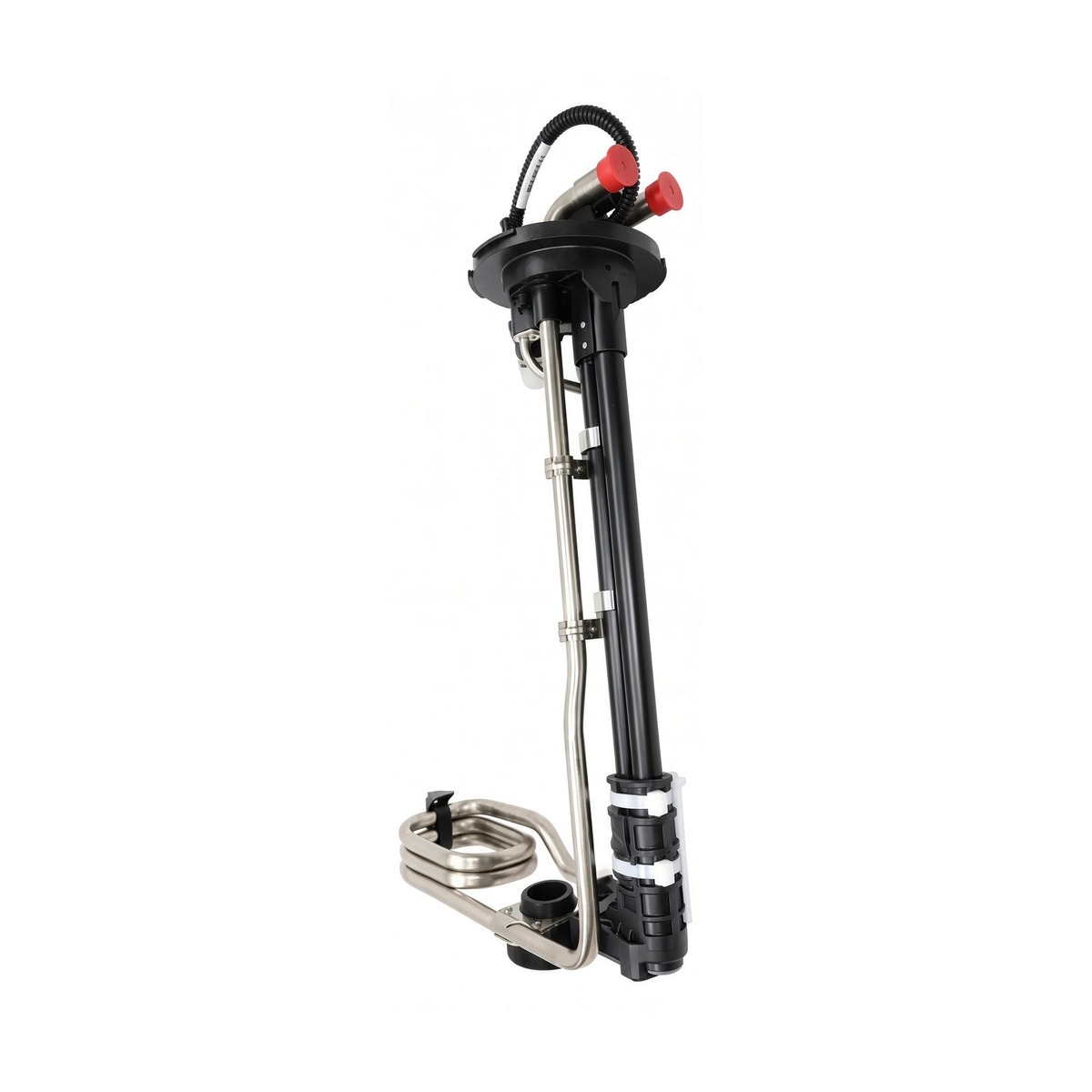
The Critical Role of the DEF / AdBlue Tank Level Sensor in Modern Fleets
In modern EPA 10, EPA 13, and Euro 6 heavy-duty diesel vehicles, the Diesel Exhaust Fluid (DEF / AdBlue) level sensor is far more than a simple float switch. It is a precision multi-function header assembly that continuously monitors four interdependent parameters essential for Selective Catalytic Reduction (SCR) operation:
- Fluid Level: Precise liquid height measurement to prevent pump cavitation and calculate dosing volume.
- Urea Concentration / Fluid Quality: Ensuring the fluid contains exactly 32.5% aqueous urea (AUS 32) within a ±1.5% refractive or acoustic tolerance.
- Fluid Temperature: Monitoring DEF temperature to initiate the tank heating loop when fluid approaches its freezing point of -11°C (12°F).
- Coolant Control Valve Integration: Modulating engine coolant flow through internal stainless steel heating coils during sub-zero operation.
When any of these integrated sensors fail or transmit erroneous CAN signals, the engine control module (ECM) triggers severe inducements, capping engine torque and derating road speed down to 5 mph (8 km/h). For commercial fleet operators, understanding how these sensors function, how they fail, and how to accurately diagnose them is essential for preventing catastrophic downtime.
Ultrasonic vs Reed Switch: Two Dominant Sensing Architectures
Modern commercial trucks primarily use two distinct sensor technologies inside the DEF tank:
1. Ultrasonic Level & Concentration Headers (Cummins, PACCAR, International)
Ultrasonic headers, widely adopted on Cummins ISX15/X15, PACCAR MX-13, and Navistar International engines (such as OEM 4378050, 2515900C1, 2122578PE), position a piezo-ceramic acoustic transducer at the bottom of a vertical measuring column. The transducer fires high-frequency sound pulses upward toward the liquid-air interface and calculates liquid level from the pulse echo transit time.
Simultaneously, acoustic velocity measurements across a fixed internal sound path determine fluid density and urea concentration. Because sound travels faster in pure water than in 32.5% urea solution, acoustic velocity shifts instantly detect water dilution, DEF crystallization, or diesel fuel contamination.
2. Multi-Stage Reed Switch Floats with NTC Thermistors (Volvo, Scania, Mercedes)
European platforms—including Volvo FH/FM, Scania R/S series, and Mercedes Actros (such as OEM 2140807, 21575532, A0001407678)—frequently employ vertical stainless steel stems containing sealed reed switch ladders and internal resistor networks. A doughnut-shaped magnetic float rides up and down the stem, closing successive reed contacts to provide a stepped voltage divider signal to the SCR dosing ECU.
Top 4 DEF Level Sensor Failure Modes & Root Causes
| Failure Mode | Primary Root Cause | Symptoms & ECM Reaction |
|---|---|---|
| Float Sticking / Jamming | Urea evaporation crystallization (biuret crusts) on the guide shaft due to hot-climate tank breathing or long idle periods. | Gauge permanently indicates empty or full; ECM logs DEF level implausible; eventual torque derate. |
| Acoustic Mirror Soot / Scale Fouling | Contaminated DEF containing minerals, dirt, or degraded oil entering tank via dirty dispensing nozzles. | Ultrasonic echo signal attenuation; false SPN 3364 (DEF Quality Poor) trigger. |
| Internal Heating Coil Corrosion / Leakage | Thermal expansion fatigue cracking the weld seams of thin-walled heating tubes, allowing coolant to mix with urea. | Contaminated urea crystallization; rapid dosing valve clogging; white exhaust residue. |
| Wire Harness Connector Corrosion | High-pressure underbody power washing forcing saline water into non-sealed 4-pin/5-pin Deutsch or AMP connectors. | Intermittent CAN communication dropout (J1939 time-out); SPN 1761 FMI 9 or 13. |
Step-by-Step Workshop Diagnostic & Testing Workflow
Before replacing an expensive tank header, field technicians should follow this rigorous verification checklist:
- Refractometer Optical Verification: Draw a 5ml DEF sample from mid-tank depth and measure on an optical or digital refractometer. Confirm refractive index reads exactly 32.5% (Brix 32.5°). If concentration is below 30% or above 35%, drain, flush tank with deionized water, and refill with fresh ISO 22241 certified DEF.
- Multimeter Harness Resistance Test: Disconnect the 4-pin header connector with the ignition key OFF. Measure pin-to-ground and circuit resistance:
- Pins 1 & 2 (NTC Temperature Sensor): Resistance should read approximately 10kΩ to 12kΩ at 20°C (68°F). If reading reads 0Ω (short) or infinite (open), the internal thermistor is fried.
- Pins 3 & 4 (Level Resistance Signal or CAN H/CAN L on smart modules): On smart ultrasonic headers, verify CAN communication lines measure ~60Ω terminating resistance across bus lines with battery disconnected.
- Float Physical Free-Travel Inspection: Inspect the float travel along the shaft. The float should glide effortlessly from top stops to bottom stops without mechanical catching or binding.
Fleet Sourcing: OEM Quality Without OE Dealership Markup
At SHR Autoparts, our aftermarket DEF Level and Quality Sensors are built with military-grade 304/316L stainless steel stems, ultrasonic transducers calibrated to OEM ISO 22241 acoustic tables, and gold-plated automotive connectors tested to IP67/IP69K waterproofing standards.
Whether you manage a fleet of North American Freightliner, Peterbilt, Kenworth, and Mack haulers, or European Volvo, Scania, and DAF transport units, explore our complete catalog of DEF Level Sensors and submit a Wholesale RFQ for volume pricing with worldwide expedited air express delivery.
AdBlue Level Sensor Solutions
Move from level sensor guidance to AdBlue application matching and B2B quotation.
Need OEM cross-reference or wholesale pricing?
Send part numbers, applications, or sourcing requirements to SHR Autoparts for a faster B2B response.